

What Actually Changes in a PVC Conduit Run: Schedule 40 VS Schedule 80
Categories:PVC Pipe and Fitting Author: author
Introduction
A schedule change is often treated like a simple pipe substitution. The note on the drawing changes, the conduit wall gets thicker, and the discussion stops there. That is rarely how it plays out on site. Once Schedule 40 becomes Schedule 80 in a conduit run, the change moves through the whole route. Internal space shifts, pull feel changes, support and bending behavior feel different in the hands, and some fittings or box assumptions need a second look. That is why the question is larger than sch 40 vs sch 80 pvc as a product comparison. The real question is what the change does to the run.
Wall thickness is only the starting point
Schedule language enters the conversation through wall thickness, and that is where many articles stop. Thicker wall, higher robustness, smaller internal diameter. Those facts are real. They still do not tell the installer or specifier what the changed run will actually feel like.
A conduit run is a route for conductors, fittings, bends, supports, entries, and future maintenance. The wall thickness change affects each of those parts indirectly. Internal area is reduced. Weight per length increases. The conduit feels stiffer when handled in volume. Directional changes and terminations start to demand slightly different attention. The route may still connect from point A to point B, though it no longer behaves exactly like the lighter schedule it replaced.
That is why a note such as “upgrade exposed conduit to Schedule 80” should never be read as a cosmetic revision. The schedule is part of the system behavior. The sooner the design team recognizes that, the fewer small surprises appear during pulling and enclosure work.
How schedule changes conduit fill, pulling feel, and run handling
The most immediate run-level change sits inside the conduit, not outside it.
Conduit fill is reduced before anyone starts pulling
A thicker wall leaves less internal room for conductors. The difference may look modest on a table, though it shows up quickly on fuller runs, longer pulls, or installations carrying larger conductors. A route that was comfortable under Schedule 40 can move closer to its practical limits after the shift to Schedule 80. If the design simply swaps the conduit callout and leaves conductor planning untouched, crews may discover the problem at pulling stage rather than at design review.
Pulling feel changes even when the route geometry stays the same
Installers often describe this as a change in feel rather than a change in theory. The conduit route may have the same bends and the same destination, yet the smaller internal space and slightly altered fit around conductors change how the pull progresses. Friction management, bend severity, lubricant choice, and pull staging become more noticeable. Longer runs that were already close to awkward under Schedule 40 can become less forgiving under Schedule 80.
Run handling becomes more deliberate
Schedule 80 is not impossible to work with by any stretch, though crews usually feel the difference in transport, staging, and assembly. The conduit has a more solid presence. Repeated cuts, dry fits, and box approaches can take a little more discipline, especially on jobs that assume the same pace as a lighter schedule. Where the design intentionally trades ease of handling for added protection, that is a perfectly rational exchange. Trouble starts when nobody budgets for the exchange.
What stays compatible and what has to be recalculated
A schedule change does not wipe out the whole design. Plenty of the route logic remains intact. The key is knowing what can stay in place and what deserves a fresh calculation.
The route concept often survives
Support locations, pathway intent, and general directional logic may remain completely valid. If the original route was sensibly drawn, the schedule upgrade usually does not force a redesign of the whole pathway. That is why schedule changes are common on projects that want more protection in selected areas without redrawing the full system.
Fill and bending assumptions deserve another pass
Conductor fill should be checked again, especially on runs that already felt tightly packed on paper. Bend planning also deserves review. A route with several changes of direction can feel very different once internal space tightens. The issue is rarely dramatic on a simple short branch. It becomes more relevant as the run gets longer, denser, or more constrained.
Transition details need explicit attention
Mixed-schedule projects create transition points. A run may begin in Schedule 40 and move into Schedule 80 where exposure or damage risk increases. That transition needs to be described clearly in the documents and understood in the fitting package. If the schedule shift is left vague, procurement teams may quote the right conduit with the wrong assumptions around couplings, accessories, or quantities.
How fittings, boxes, and layout decisions are affected
The change becomes most visible where conduit meets hardware.
Fittings are part of the schedule decision
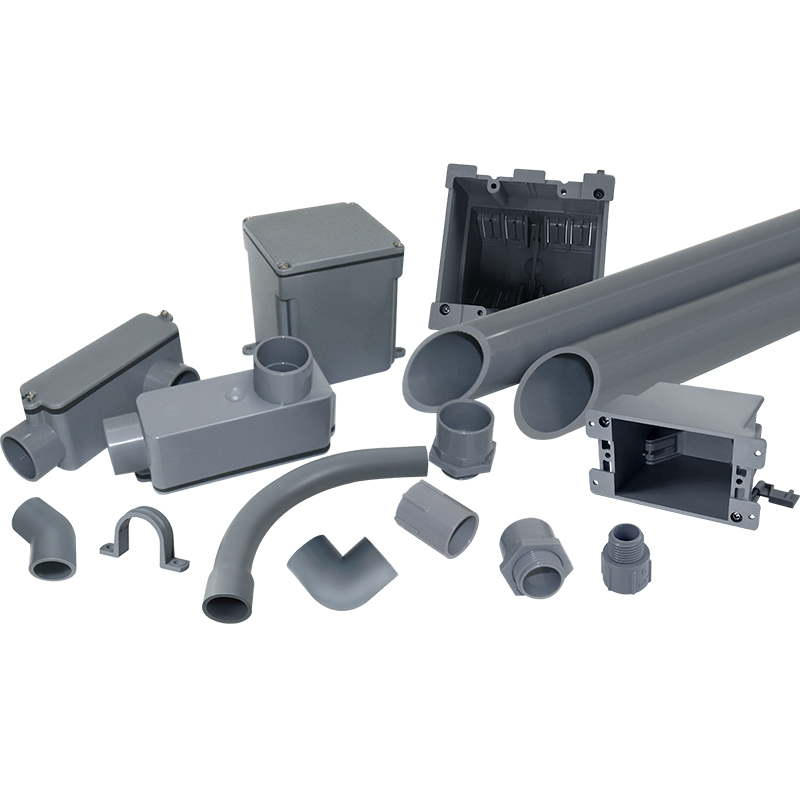
A schedule note does not sit in isolation from the fitting family. Elbows, couplings, adapters, and box entry components have to suit the revised run. On a catalog like ulpipes.com, Schedule 40 and Schedule 80 conduit lines are presented alongside associated fittings for a reason: the run is assembled, not abstract. If the conduit changes and the fitting logic stays lazy, the job starts leaking time in the field.
Box entries may need a more careful approach
Boxes often expose the difference between a pipe-level decision and a run-level decision. The installer is no longer looking at a conduit label. They are making up an entry, securing the fit, managing conductor clearance, and finishing the route cleanly. A schedule upgrade can change how crowded the approach feels and how neatly the connection is resolved, particularly where multiple entries land close together.
Layout choices can shift for labor reasons
A tougher schedule may encourage slightly different layout choices even when code would permit the original route. Designers or installers may prefer cleaner lines, gentler pull paths, or more strategic box placement to avoid turning a straightforward run into a labor-heavy one. None of that suggests Schedule 80 is a problem. It simply means the run now carries a different balance between protection and installation convenience.
Why schedule differences should be described at run level, not pipe level only
“Use Schedule 80 here” sounds precise until someone asks what “here” actually means. Is it the full feeder? Only exposed sections? Only portions below a certain height? Only risers in vehicle zones? Pipe-level language often sounds specific while still leaving the route open to interpretation.
Run-level language is more useful. It ties the schedule to the condition of the installation. Exposed lower-wall conduit in service corridors may be Schedule 80. Interior concealed branch conduit above ceilings may remain Schedule 40. Exterior sections, parking levels, utility rooms, and equipment drops can be addressed by location or risk class. That wording tells estimators how to count, tells buyers what to source, and tells installers where the transition begins.
Run-level wording also reduces hidden redesign. Once the schedule change is attached to route conditions, everyone involved is more likely to revisit fill, bends, fittings, and terminations before the material arrives. The project stays coordinated because the schedule note is acting like system information rather than a product swap.
The larger lesson behind sch 40 vs sch 80 pvc is simple: the wall thickness difference is real, though the project consequences are wider than the wall itself. Conduit fill, pulling feel, handling, fittings, box entries, and route definition all move when the schedule moves. The teams that manage that shift cleanly are the ones describing a run, not merely naming a pipe. A supplier with full SCH40 and SCH80 conduit-and-fitting coverage, such as ULP, is easier to work with.